Cut the customer base by what you know
An average hides where the money is and where it leaves. sumwerk cuts paying customers, MRR, the churn of the last twelve months and trial conversion by plan, billing interval, owner, tag, country or any attribute of your own.
Start free Read the guide to plans Free during early access. Read-only Stripe key, hosted in Germany.
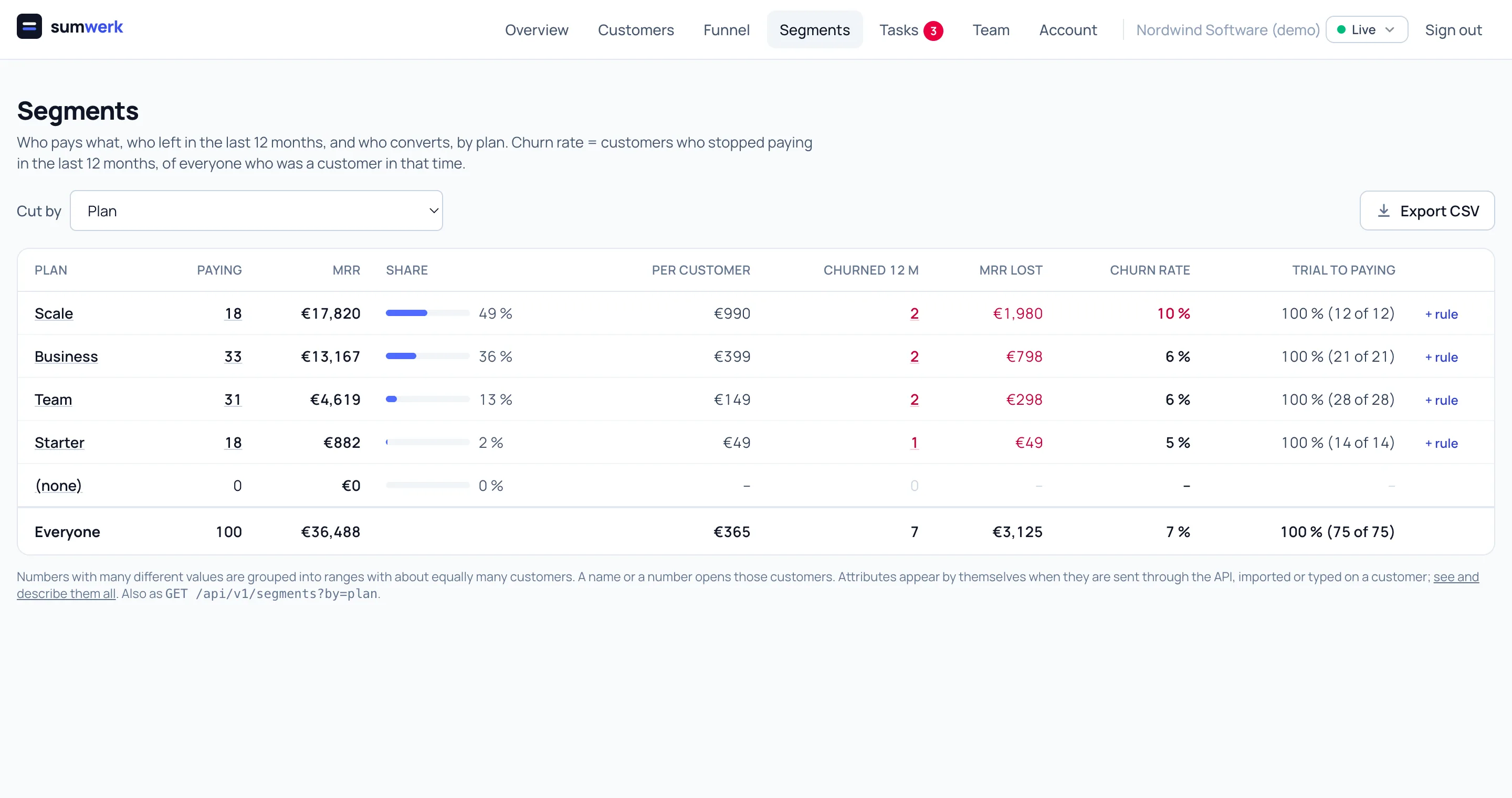
Plans come from Stripe by themselves
A customer's plan is the Stripe product of their largest subscription item, so an add-on never names the plan, and someone who left keeps their last plan. The billing interval comes with it: monthly, yearly, every six months.
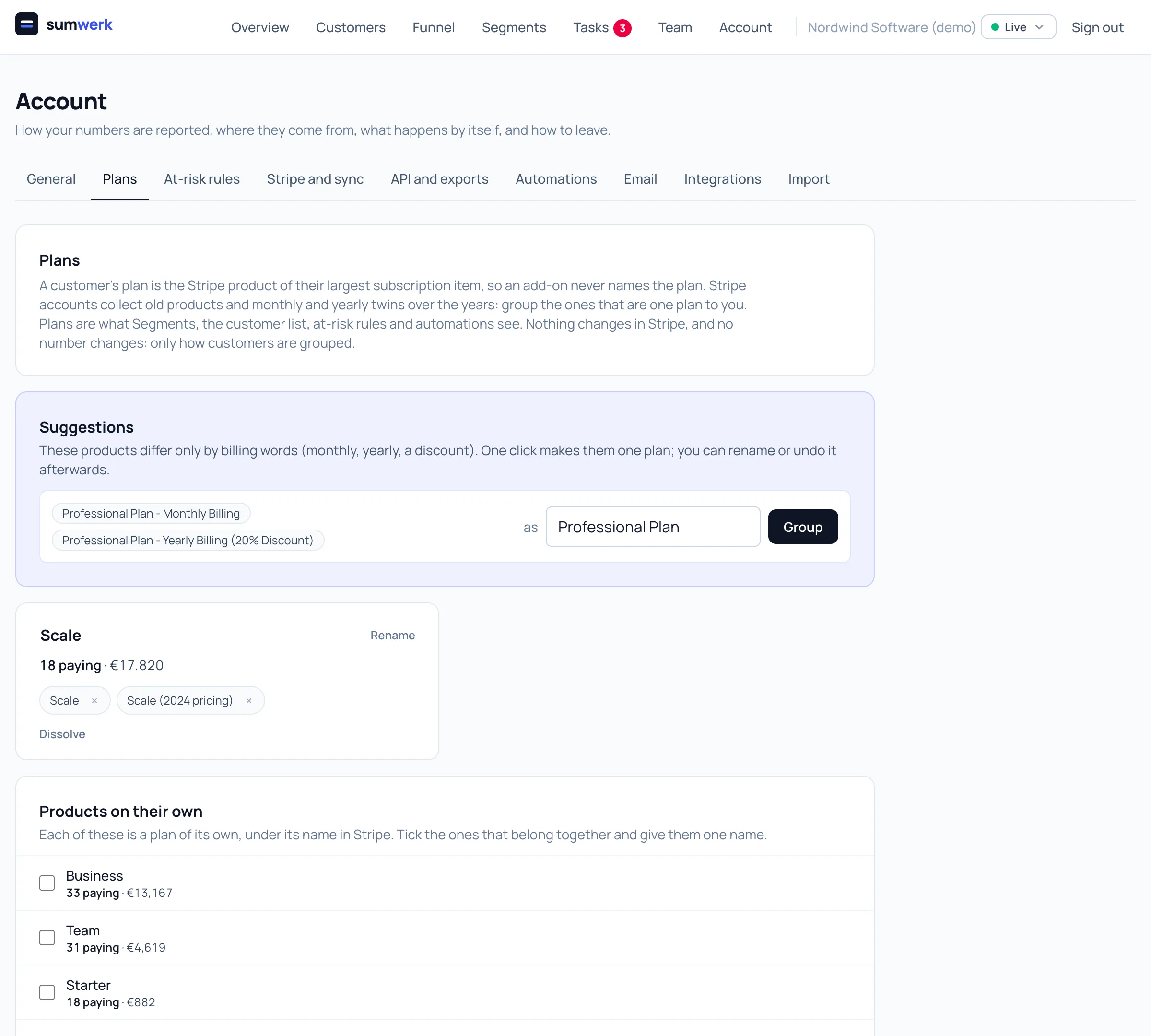
Your plan names, not your product catalogue's history
Most Stripe accounts carry old products and monthly and yearly twins of the same plan. Tick the products that are one plan to you and give them one name; sumwerk suggests the obvious groupings itself. From then on they are one plan everywhere: in segments, in the customer list, in rules and in exports. Nothing changes in Stripe.
Any attribute you send
Seats, company type, product usage: whatever your product writes through the API is a dimension the moment the first value arrives. Numbers with many values are grouped into ranges with about equally many customers, and the value most customers share (often 0) gets a row of its own.
From a row to the customers, and to a rule
Every row opens the customers behind it, paying or churned. And every row can become an at-risk rule with one click: if customers with no active user churn five times as often, flag the ones who pay today.
Questions
- Does a customer with two tags count twice?
- In the rows of both tags, yes. The total row counts everyone once.
- Can I describe what an attribute means?
- Yes. Every attribute takes a label and a description, which show wherever the attribute does.
Goes well with
- Churn and retentionCustomer churn, gross and net MRR churn for every month, and net and gross revenue retention over twelve months, with the definitions next to the numbers.
- MRR at risksumwerk flags revenue that still counts but is in doubt - failed and overdue payments, scheduled cancellations - by severity, without changing your MRR.
- CustomersA customer in sumwerk exists independent of Stripe: leads and trials from your product, several Stripe customers under one record, attributes, tags, owners.
Connect Stripe and check your own numbers
A restricted, read-only key is all it takes. The first import runs in a few minutes; every number you see opens into the customers and Stripe references behind it.