MRR you can prove
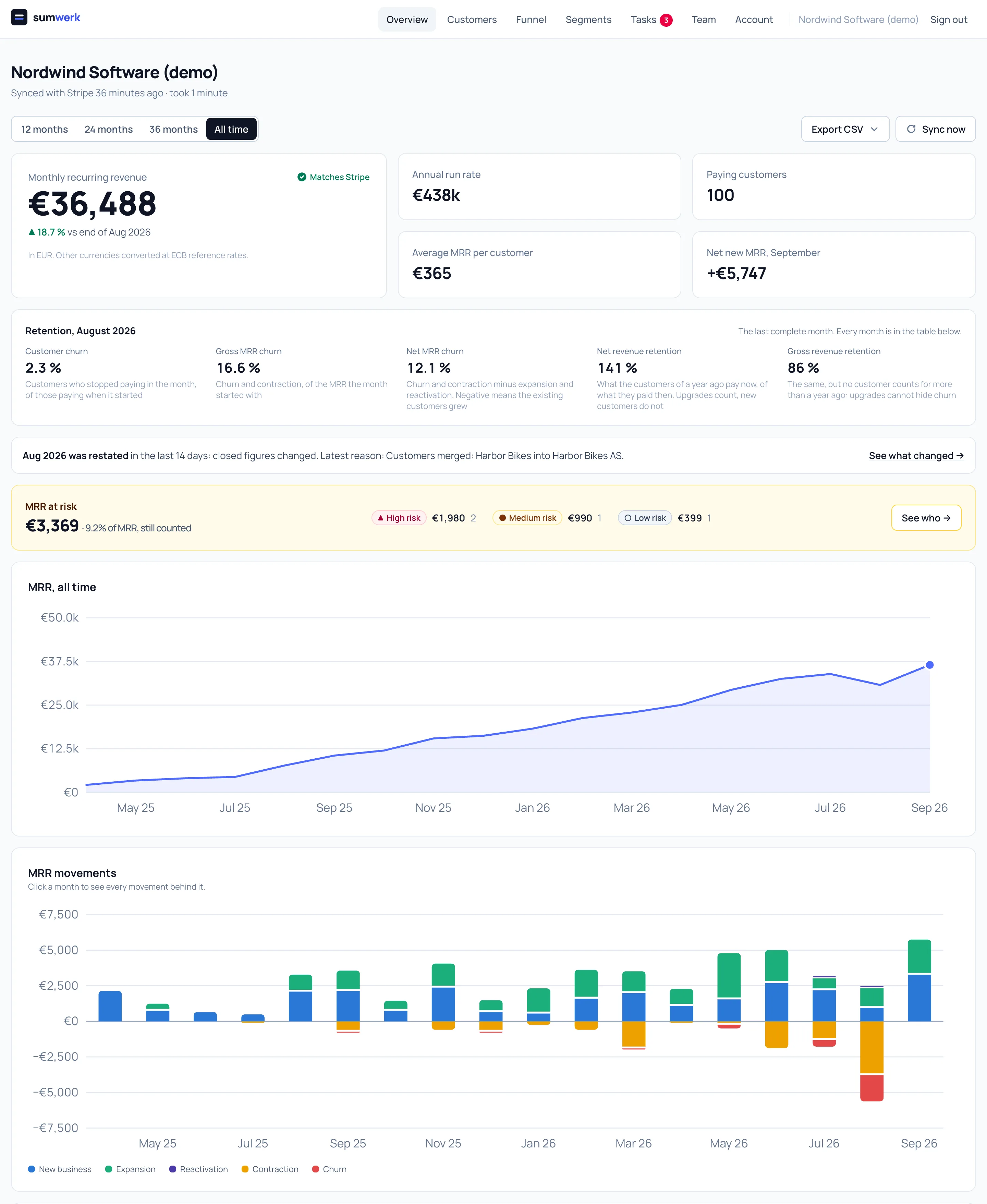
Every number on the dashboard opens into the customers behind it, and every movement names the Stripe invoice or event that caused it. When finance asks why MRR moved, you click instead of guessing.
Start free Free during early access. Read-only Stripe key, hosted in Germany.
Computed from subscription state, not from invoice amounts
MRR is price times quantity, normalised to a month, minus the discounts that are active right now. A plan change in the middle of a billing period produces a prorated invoice in Stripe; tools that read MRR off invoices turn that proration into a spike one month and a dip the next. sumwerk reads the subscription itself, so an upgrade is one expansion on the day it happened.
Every movement carries its evidence
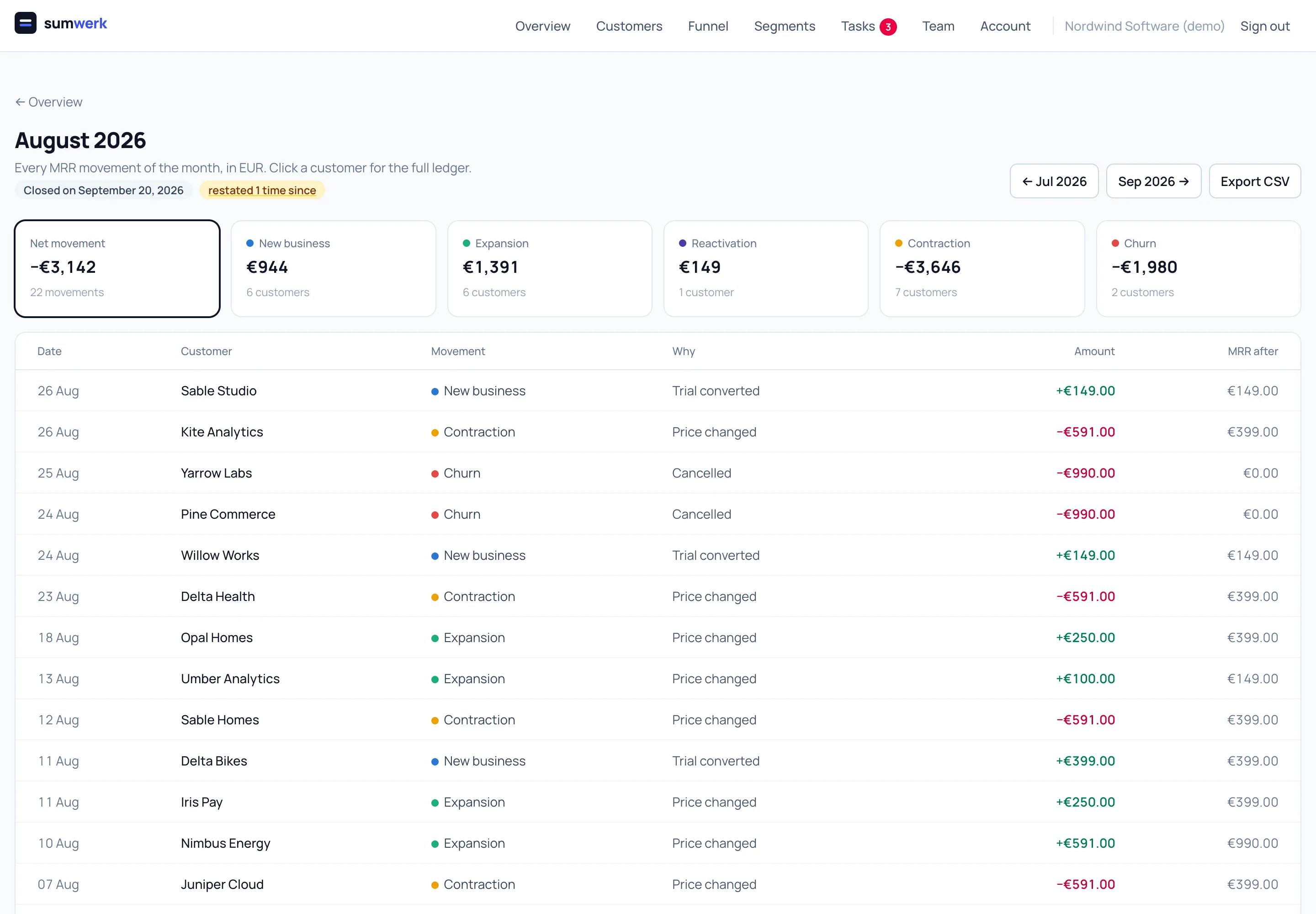
New business, expansion, contraction, churn and reactivation are listed per month and per customer. Each one shows its cause (trial converted, price changed, discount ended, cancellation) and the Stripe ids it was derived from. Where no invoice or event explains the exact day, the movement says so instead of pretending.
Click from a month into the customers
Open any month, or any kind of movement within a month, and see every customer in it with the amount before and after. Twelve, 24 or 36 months, or all time.
Several currencies without surprises
Customers are valued in the currency they pay in. The report converts at the European Central Bank's reference rates and shows the effect of exchange rates as a line of its own, so a stronger dollar never looks like growth.
Checked against Stripe after every sync
A number you cannot check is an opinion. After every recalculation sumwerk compares what it values each subscription at with what Stripe's latest regular invoice bills for the same items, per month, to the cent. The overview says how many agree, and a difference is listed with the subscription and the invoice, not hidden. The invoice is Stripe's own arithmetic, so a wrong price, quantity, currency or billing interval has nowhere to hide.
Churn and retention, defined in the open
Customer churn, gross and net MRR churn for every month, measured against what the month started with. Net and gross revenue retention over twelve months follow the customers who paid a year ago: upgrades count in the net figure, new customers never do, and in the gross figure an upgrade cannot hide a cancellation. The definitions are printed next to the numbers.
Closed months stay closed
A month closes a few days after it ends (five by default, you choose). From then on its figures are frozen. When a late invoice, a merged customer or a changed setting would give a closed month other numbers, sumwerk records a restatement: the date, the reason, the figures before and after, and the customers behind the difference. The number you reported last quarter does not change without a note, and the API tells your own reports which months are final.
Read-only by design
You connect Stripe with a restricted key that can only read. Standard secret keys are refused. The key is encrypted, never shown again, and sumwerk never writes to your Stripe account. Data is stored in Germany.
Questions
- How often is the data updated?
- Every hour, and whenever you press "Sync now". A regular sync takes about half a minute. If you need it faster, add a Stripe webhook (optional, three steps) and changes arrive within about a minute.
- Do trials and paused subscriptions count as MRR?
- No. A trial counts from its first real payment. A subscription that is past due keeps counting while Stripe still retries, and is flagged as MRR at risk.
- Can I get the numbers out?
- Yes. Months, movements and customers as CSV, and everything the dashboard shows through a JSON API.
Goes well with
- MRR at risksumwerk flags revenue that still counts but is in doubt - failed and overdue payments, scheduled cancellations - by severity, without changing your MRR.
- CustomersA customer in sumwerk exists independent of Stripe: leads and trials from your product, several Stripe customers under one record, attributes, tags, owners.
- APIPull MRR, movements and customers out of sumwerk, push leads, trials, product usage, notes and tasks in, manage automations and receive signed webhooks.
Connect Stripe and check your own numbers
A restricted, read-only key is all it takes. The first import runs in a few minutes; every number you see opens into the customers and Stripe references behind it.